eBay Messages 2030 vision exploration
Project Overview
A vision for eBay Messages that helps a buyer and a seller each see where their deal stands and what needs their attention next. I led the exploration over several months and built the prototype for a leadership pitch that was never presented.
Industries
Marketplace
Communication
AI
Services
Vision lead
Two-sided prototype
Leadership pitch
Year
2026


Сhallenge
Buyers and sellers ask questions, agree on a price and sort out problems in Messages, but finishing the deal still happens elsewhere. Each person has to work out where things stand and whose turn it is. Some commerce actions already live in Messages, so I spent several months exploring what Messages could become if the conversation and the state of the deal worked together, and built a pitch and prototype to make it tangible.


Design Approach
I proposed one contextual banner that reads the conversation and the state of the deal for both people. It says why it appeared, offers one next step, and always lets the person dismiss it. When nothing is needed, it says so. As I extended the concept, I added states for conflicting signals and wrong suggestions, and an order for when several things qualify. The same banner works across offers, payment, shipping, pickup and problems. More help comes only with permission: purchases and other money decisions always need explicit confirmation, and pre-approving small spends is an open question for the next iteration. Each part has one job: the thread holds the people talking, the banner holds what’s next, and a record you pull in from the side holds everything that happened. It goes after images 2–5 (next-action anatomy, shared pattern, trust, record), since FolioBase shows each text field after its images.

Results
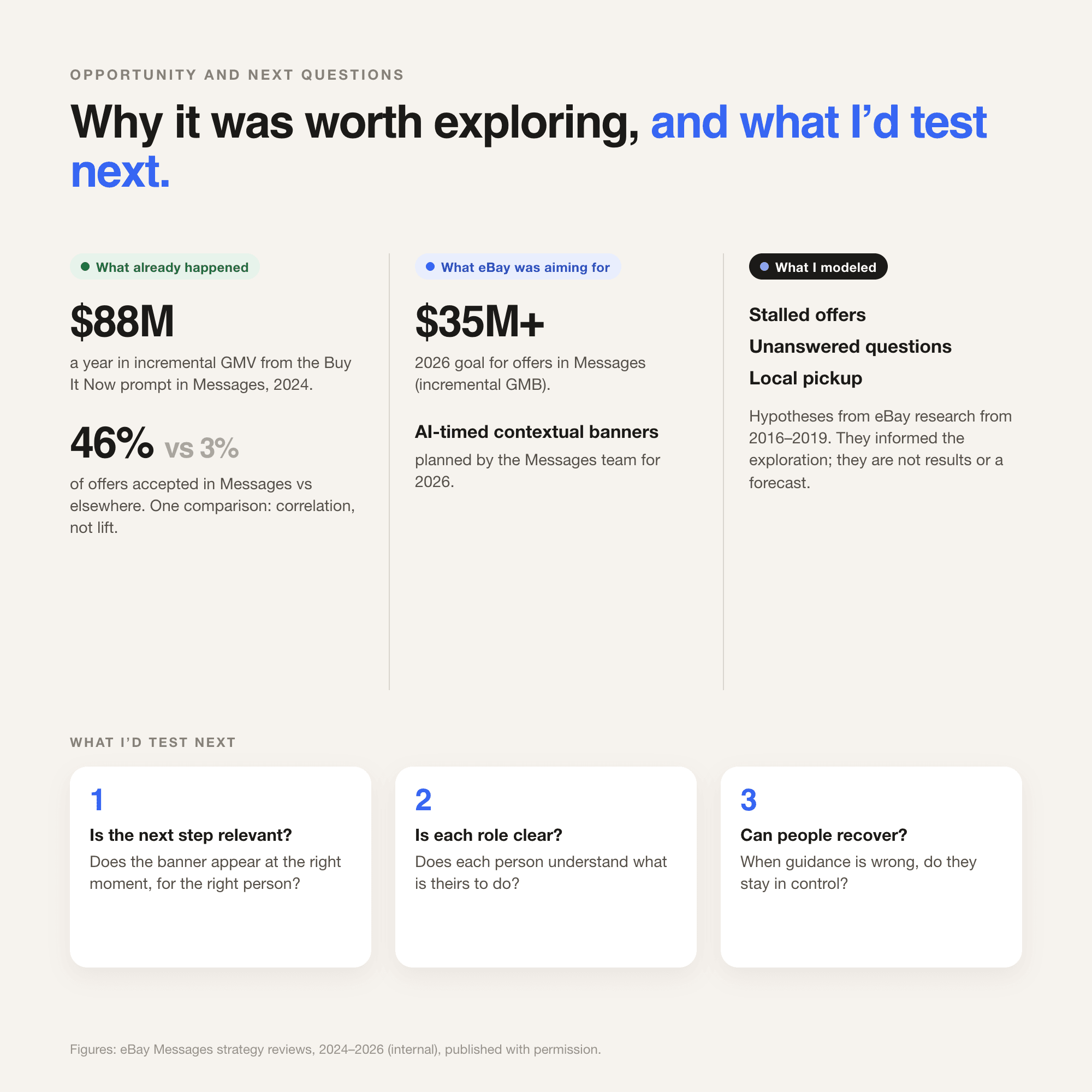
Commerce actions already working in Messages gave a reason to explore this: the Buy It Now prompt brought in $88M a year, and offers sent in Messages were accepted 46% of the time versus 3% elsewhere. My own opportunity estimates were hypotheses, not results. The work produced a two-sided prototype, a shared interaction proposal, and a progression from guidance to permission-based help. Next, I’d test whether the next step feels relevant, whether each person understands their role, and whether people stay in control when the guidance is wrong.